
Clarendon County Court Records After Arrest
The arrest-to-court path starts at the Clarendon County Detention Center. Staff confirm arrest paperwork, search and process the detainee, take fingerprints and a booking photograph, and schedule the person before a magistrate once charging documents have been served if bond applies. That jail process is not the final court record. The court record opens when a case is filed, indexed, or transferred into the proper South Carolina court.
Formal prosecution in Clarendon County is handled through the Third Judicial Circuit Solicitor's Office. The circuit covers Clarendon, Lee, Sumter, and Williamsburg Counties, and the research identifies Ernest A. Finney III as solicitor. A booking charge can differ from the court charge after review. A charge may be amended, reduced, dismissed, nol prossed, indicted, or moved to another court level. For custody and booking details, use Clarendon County jail inmate records; for booking photos, use the Clarendon County jail mugshots page.
Search Clarendon County Court Records
The official search route is the South Carolina Judicial Branch case-records system and the Clarendon County Public Index. The Judicial Branch warns that browser cookies, JavaScript, and pop-up settings can affect access. If the online index is slow, rate-limited, or missing an older file, contact the Clerk of Court rather than relying on unofficial databases.
- Open the South Carolina Judicial Branch case-records search.
- Choose Clarendon County and use the Clarendon County Public Index.
- Search by defendant name first if the case number is not known.
- Open each matching case and compare the charge list, court type, filing date, and status.
- Check for more than one case, because one arrest can involve magistrate, municipal, family, or General Sessions records.
The Clarendon County Public Index screenshot is the best match for the core lookup task.
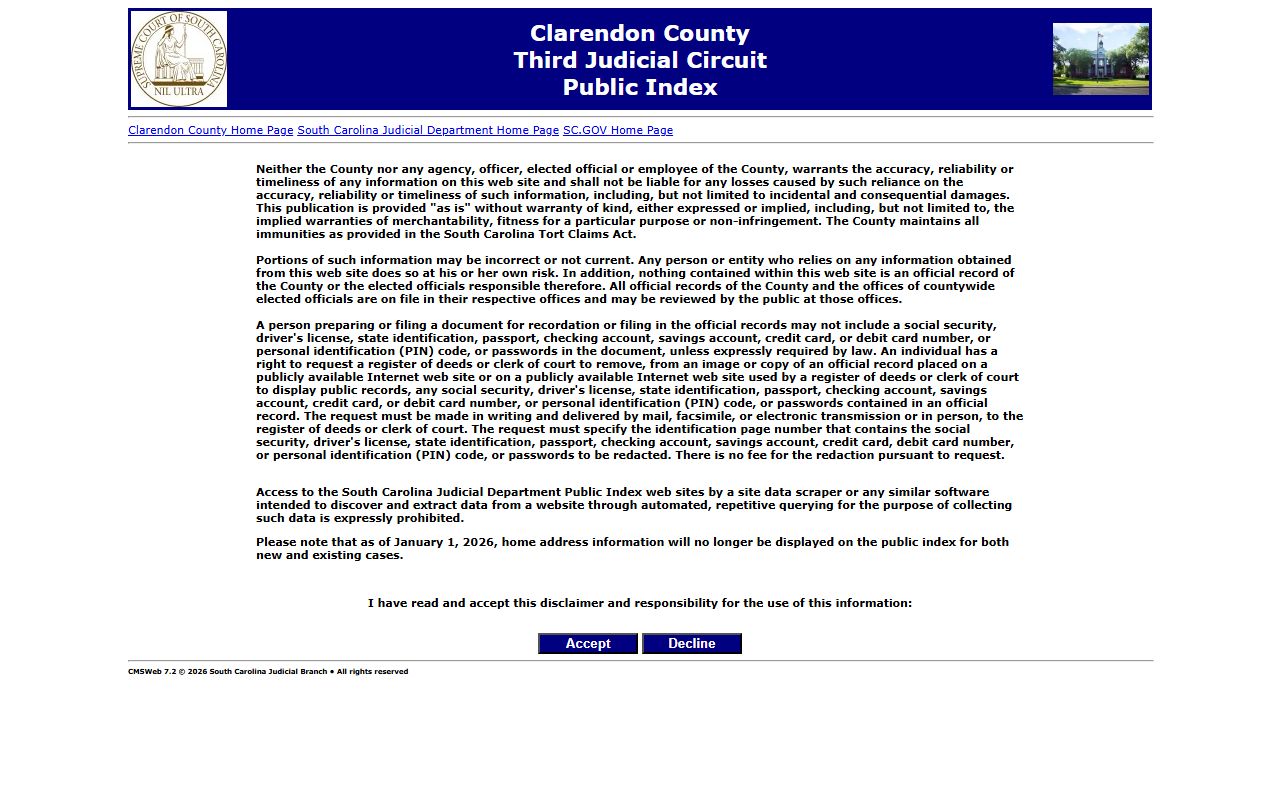
The index is the court side of the search. It does not replace a jail custody check when the question is whether someone is still detained.
Clarendon County Court Search Fields
The court search fields differ from the jail intake fields. A jail record may use detainee ID, booking details, and bond-hearing notes. A court case search usually works from party name, case number, court type, and date windows. Use exact names when possible, then broaden the search if the arrest date and filing date do not match.
| Field Label | Type | Required | Notes |
|---|---|---|---|
| County | Link or dropdown | Yes | Select Clarendon from the SC Courts county links. |
| Case Number | Text | Optional | Use if known from citation, warrant, bond paperwork, or clerk notice. |
| Last Name | Text | Optional | Defendant last-name search is the usual starting point. |
| First Name | Text | Optional | Use with last name to narrow common names. |
| Date or date range | Date | Optional | Use filing, arrest, or court-date windows where available. |
| Court agency or court type | Dropdown | Optional | Circuit, magistrate, and municipal coverage can vary. |
Clarendon Clerk Court Records
The Clarendon County Clerk of Court page says criminal and civil record requests may be made in person, by mail, or by fax. The office gives a 24-hour turnaround for record requests, though files not located in the courthouse may take longer. The clerk also says the office does not provide research, so a request should be specific.
The same page lists copy charges: $10 for the first four pages and $0.25 per page after that. Public Defender applications are handled during normal business hours with a $40 non-refundable fee, payable by cash or money order, and Public Defender questions go to 803-433-0188. Those details matter when court records after a jail arrest turn into a request for copies rather than a free online lookup.
The official Clerk of Court page shows the county copy-fee and Public Index instructions.
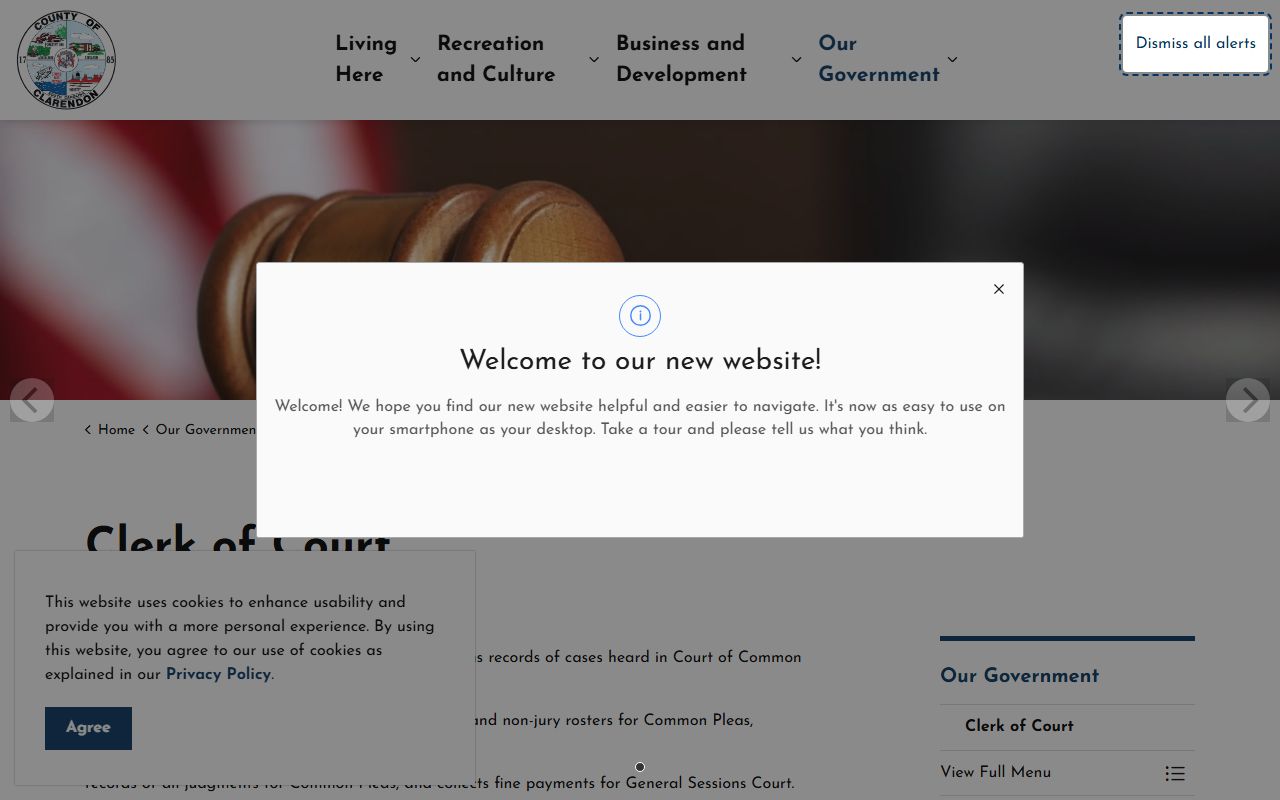
Use the clerk when a case is older, a copy is needed, or the Public Index does not show enough detail.
Charges Filed After Jail Arrest
South Carolina cases can move through different charging documents and court levels. Clarendon County research supports the basic distinction, but it does not prove that every arrest has the same document path. A magistrate may handle initial bond information, while the solicitor controls prosecution in General Sessions matters. The filed court charge is the charge that should be tracked for status and disposition.
| Document | Who Uses It | What It Does |
|---|---|---|
| Complaint or warrant paperwork | Law enforcement or court | Supports the arrest, booking, or initial charge record. |
| Information | Prosecutor | States the charge the solicitor elects to prosecute when used. |
| Indictment | Grand jury and prosecutor | Moves many serious General Sessions charges forward after review. |
Clarendon Charge Status Records
Charge status can change after arrest. A booking charge is an arrest label. A court charge is a case label. A final disposition is the outcome. Read each line in the Public Index with that order in mind, especially when older warrants, bench warrants, or multiple court levels are involved.
| Status | Meaning |
|---|---|
| Pending | The case or charge remains open. |
| Amended | The charge changed after filing. |
| Reduced | The prosecutor or court changed the offense to a lesser charge. |
| Dismissed | The charge ended without conviction. |
| Nolle prosequi | The solicitor chose not to prosecute the charge. |
| Disposed | The court entered an outcome such as guilty, dismissed, or not guilty. |
Bond Records After Arrest
Clarendon County bond hearings are held at 8:30 a.m. and 5:30 p.m. daily, or at other times set by the duty magistrate. The county says four assigned magistrates rotate weekly. A detainee is scheduled before a magistrate after charging documents are served when bail consideration applies. People held for contempt or bench warrants from Family Court, Magistrate Court, Municipal Court, or General Sessions Court do not receive ordinary detention-center bond hearings and remain in custody until summoned to the court.
| Bond Type | Clarendon and South Carolina Meaning |
|---|---|
| Recognizance or PR | Release on a promise to appear when the court finds appearance and safety are reasonably assured. |
| Surety bond | Release backed by an approved surety, often a bondsman. |
| Cash or percentage bond | Cash terms set by the court, with state law allowing a percentage deposit in some cases. |
| No bond or hold | Release is not available through routine posting, often because another court or warrant controls custody. |
Call Booking and Release Information at 803-435-8831 or 803-435-0697 before posting bond or traveling. Confirm whether all charges are covered, whether a detainer remains, and whether the jail has the official release paperwork.
Third Circuit Solicitor Records
The Third Judicial Circuit Solicitor's Office is a key source for prosecution context after a Clarendon County arrest. The office is hosted at the Sumter County Judicial Center, 215 N. Harvin St., Sumter, SC 29150, phone 803-436-2185, with Monday through Friday hours from 8:30 a.m. to 5 p.m. The solicitor decides how General Sessions charges proceed, whether charges are amended or dismissed, whether indictments are sought, and whether plea or trial resolutions are pursued.
The Third Judicial Circuit Solicitor page gives the official prosecution contact details.
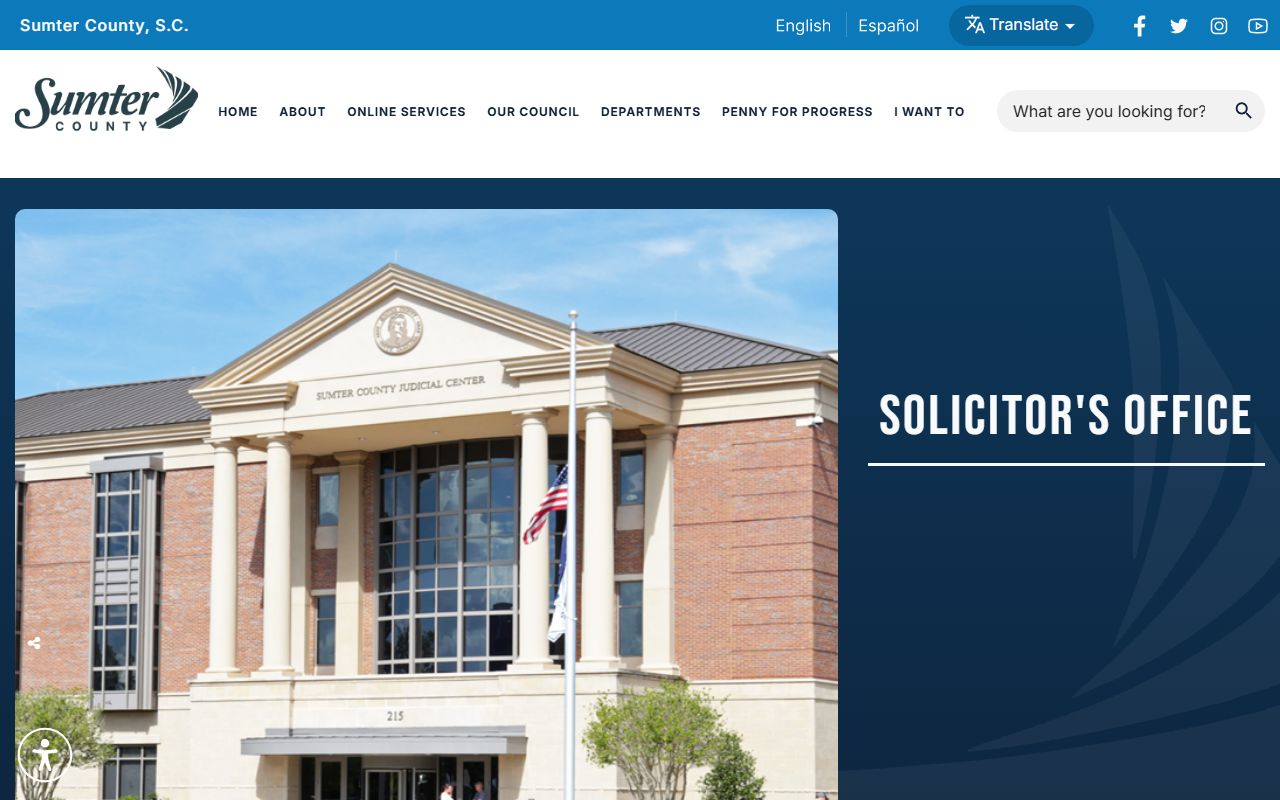
Use the solicitor for prosecution questions, not current custody or jail release timing.
Charges Convictions Sealed Expunged
Two comparisons prevent common mistakes in Clarendon County court records after an arrest. First, a charge is not a conviction. Second, a sealed record and an expunged record are not the same thing. South Carolina expungement rules appear in Title 17, Chapter 22, and the research notes Section 17-22-910 applications through solicitor offices.
| Question | First Item | Second Item |
|---|---|---|
| Charge vs. conviction | A charge is an accusation or filed offense after arrest. | A conviction is a guilty plea, verdict, or other formal finding. |
| Sealed vs. expunged | Sealed records are hidden from general public access under a court or statute rule. | Expunged records are destroyed or retained only in limited sealed forms allowed by law. |
| Court record vs. criminal-history check | The court record tracks a case in a specific court. | SLED CATCH is a paid South Carolina name-based criminal-history check. |
Important: This private reference site is not a consumer reporting agency and is not for FCRA-covered screening uses.
Restricted Arrest Court Records
Not every record tied to an arrest is public in full. Juvenile records, sealed files, expunged records, active investigations, protected victim information, body-worn-camera data, and legally exempt material may be withheld or redacted. The sheriff FOIA form cites a South Carolina body-camera exclusion, and the research warns that public records cannot be used for commercial solicitation directed to a South Carolina person.
Use South Carolina FOIA, Title 30 Chapter 4, Title 17 Chapter 1, and Title 17 Chapter 22 for the legal framework. Court records after a jail arrest should be verified through the court, clerk, solicitor, or originating law-enforcement office before action is taken.